


Wenzhou Lisheng printing and packaging machinery co, LTD is located in pingyang county, zhejiang province. We have started manufacturing the flexo printing machine since 2005. We are professional manufacturer of various kinds of flexo printing machines including stack type flexo printing machine, central impression flexo presses and inline type flexo printing machine, applicable to printing paper, film non-woven fabrics, woven bag packaging materials, etc. Thanks to state-of-the-art technologies and innovative business ideas, our company products sell well all over the world.
Rich Products
Lisheng specializes in manufacturing high-quality printing machine, including but not limited to: Flexo Printing Machine, Packaging Printing Machine, Flexographic Printer, Paper Printing Machine, Plastic Printing Machine, and Woven Printing Machine, which can be applied to printing paper, film non-woven fabrics, woven bag packaging materials, etc.
Quality Control
Lisheng boasts first-class production facilities located in the industrial heartland of China. Our factory operates under strict quality control supervision and adheres to all international manufacturing practices to ensure every piece of equipment meets the highest standards. All of our products undergo CE and ISO international certifications, ensuring product quality and safety.
Wide Range of Applications
As an international leader in Flexo Printing Machine manufacturing area, Lisheng provides high quality products to customers around the world. Our proudcts are widely used in the field of luxury goods, clothing, food and beverage, sport brand, wine, tea, etc.
Ongoing Support and Service
Our service doesn't stop when your machine is delivered. We provide full, ongoing training for your team, either at our facility or your location – whatever is most convenient for you. We also supply an assortment of spare parts and consumables, and offer flexible maintenance plans to extend the working life of your machine.

The 4 Color Printing Machine adopts a sloping back design, and the mechanical action of printing and die-cutting is a gradual contact, so that the pressure can be averaged, no matter when printing a large area of background color or small characters, it can be clear and flawless. It has a built-in centralized oil supply system to ensure low noise and no wear during high-speed operation. The machine adopts single-phase power input, which is not limited by site and power configuration.

6 Colors Printing Machine adopts automatic deviation correction, constant tension control, and has a material change warning, automatic material change without stopping. It has the function of material break stop. It uses cast iron material wallboard, which is the guarantee for the stable operation of the machine. The machine is driven by a separate servo for the color group, the plate roller travels at a constant speed, and the computer controls the bag length and variable speed cloth printing. It is equipped with a closed high-speed circulation oven, which can guarantee short-distance high-speed drying.

The X, Y, and angle of each oil pan seat of the 8 Colors Printing Machine are independently adjustable, and the color registration is good, which can improve the production efficiency. It selects hardened shafts and bearings from famous manufacturers to ensure less maintenance and less wear and tear, and greatly prolong the life of the parts. The fully automatic scraper system of the machine can be made of nylon plate or steel plate, with good color registration, which can improve production efficiency and quality. Its printing table has vertical and horizontal adjustment and self-locking device.

The Color Printing Machine uses modular product accessories. It directly prints the graphics and text on the computer on the printing medium through the nozzle of the inkjet printer. The operation is simple and convenient, the printing speed is fast, and the printing cost is low. The machine does not need plate making and repeated color registration process, and the operation is simple and easy to maintain. It has fast printing speed, low input cost, high-speed printing, and is fully suitable for industrial mass production.

Stack Type Flexo Printing Machine
The Stack Type Flexo Printing Machine is set up with stations arranged vertically. Most Stack Type Flexo Printing Machines average between six and eight decks. They can be set up to allow both sides of a substrate to be printed during the same trip through the Stack Type Flexo Printing Machine. However, the Stack Type Flexo Printing Machine is less effective for thinner substrates, as it fails to hold a high level of precision.

The Ci Flexo Printing Machine opens and closes automatically and features plate cylinder bearings with a preload system for greater stability. Combined with smart SETTM, it reduces waste of substrates and consumables during start-up and changeovers. The machine increases the uptime of the printing press with the combined action of the two-piece doctor blade chamber, intelligent inking and easy-cleaning system. Dual technology channels combined with heat recovery system ensure better drying performance and energy saving.
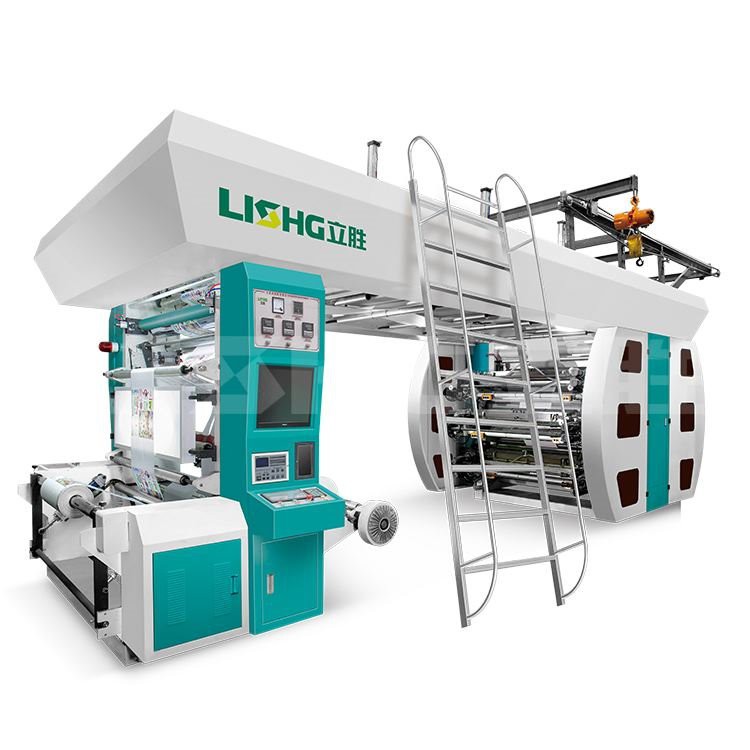
Central Drum Flexo Printing Machine
The Central Drum Flexo Printing Machine utilizes the second-order control characteristics of motor control, which can guarantee good stability and high tracking performance. At the same time, it overcomes the shortcomings of the first-order linear link of the magnetic powder brake clutch system, making the tension control more stable and less consumption during the feeding process. The machine uses a new type of transfer device, that is, half of the print is around the cylinder, and then transferred to the other half of the print through a 45° transfer mechanism. In this way, the actual effect of front and rear 8-color printing can be achieved on 8 color groups.

This is 8 color flexofraphic printer suitable for PE PET BOPP PVC printing with joist barrow

This is 4 color flexographic printing press with servo motor ,speed is 250m/min
What Is Flexographic Printing Press?
A Flexographic Printing Press is a large printer made up of flexible plates and rollers. It is a modern version of letterpress, evolved with high speed rotary functionality, which can be used for printing on almost any type of substrate, including plastic, metallic films, cellophane, and paper. Flexography uses flexible photopolymer printing plates to imprint images across a wide range of surfaces, making it one of the most efficient methods for large volume requirements. It is commonly used to print high volumes of labels and flexible packaging.
Versatility
Flexographic printing is incredibly versatile, allowing it to be used on a wide range of materials and surfaces. Whether it's paper, cardboard, plastic, or even metallic films, flexo printing can effectively and efficiently print on various substrates. This adaptability makes it an ideal choice for packaging applications, where different materials and designs are required to meet specific branding and product requirements.
Cost-Effective Production
One of the primary reasons for the popularity of flexographic printing is its cost-effectiveness. The flexo printing process utilizes flexible printing plates and fast-drying inks, which result in reduced setup and production costs compared to other printing methods. Additionally, flexo printing is known for its high-speed production capabilities, enabling large volumes of prints to be produced quickly. The combination of cost-effectiveness and efficiency makes flexographic printing an attractive option for both small and large print runs.
Superior Print Quality
Despite being a cost-effective solution, flexographic printing does not compromise on print quality. The use of photopolymer plates, improved ink formulations, and advancements in press design have all contributed to achieving excellent print quality. Flexo printing is especially popular for applications that require fine details, sharp images, and precise color reproduction, such as labels, tags, and packaging materials.
Efficient Ink Usage
In flexographic printing, the inks used are transferred directly to the substrate, minimizing ink waste and reducing environmental impact. The process involves the use of rollers, which efficiently control the ink flow and ensure uniform coverage. This efficient ink usage not only reduces costs but also makes flexo printing an environmentally friendly option compared to other printing methods.
Speed and Productivity
Flexographic printing is renowned for its high-speed production capabilities. The modern flexo presses can achieve impressive speeds, enabling rapid turnaround times and meeting tight deadlines. This speed and productivity are particularly valuable in industries where quick response times and short lead times are crucial, such as the packaging and labeling industry.
Sustainability
Flexographic printing is an eco-friendly printing method that uses water-based inks and produces minimal waste. This makes it a sustainable choice for manufacturers and brand owners who are looking to reduce their environmental impact.
Applications of Flexographic Printing Press
Flexographic printing is emerging as one of the most efficient printing technologies, making it a top choice for numerous demanding industries. Due to its versatility and exceptional printing quality, it can be found in countless applications. Some of these include the following:
Newspaper and Print Media
The primary use of flexographic printing is in organizations that have vast and bulky printing work that is needed within a short period. Flex printers are therefore used in printing newspapers and other print media such as books, magazines, posters, and flyers. Moreover, other printing needs such as wallpaper, containers, and print envelopes can also be done with the use of Flexographic Printing Presses. Although the print quality is very high, advances continue to be done in the area of ink with the sole purpose of improving print quality.
Self-Adhesive Labels
Most of the retail products have labels. It is common for the labels to be done manually, but for the last few years, labels are being done by the use of machines due to the increased organizational production, which makes it hard for manual labeling. Flexographic Printing Presses have been regularly used in printing labels for various retail products. It can print on many label materials, such as paper, film, and foil, making it a versatile choice for product labeling and marking.
Flexible Packaging
Most of the printers are only accustomed to rigid printing materials, which means that they cannot be used in printing non-rigid materials. However, Flexographic Printing Presses are currently being used in printing non-rigid materials. It is now easy to print materials such as plastics and even polythene, which cannot be printed by either digital or traditional printers. Flexographic printing has become an ideal choice for industries that use plastics or polythene to label and package their products.
Food Packaging
Printing food packages is a sensitive aspect because the safety of food is an issue of concern. Most of the printers use toxic ink that does not dry quickly. However, flexographic printing uses a quick drying ink which is not harmful to food. Flex printers are mostly used in printing food packages such as food containers, beverage containers, and milk cartons. Most of the food production and packaging companies around the world are currently using Flexographic Printing Presses for their printing needs.
Medical Packaging
Just like food, medical packaging is a very sensitive undertaking, which requires care and precision when printing. This means that toxic ink which cannot dry within a short period is not preferred. This makes flexographic printing to be the ideal printing on medical supplies and medicines. All other medical packages are printed using flex printing. This printing technology can also be used in plastic, hygiene bags, and on foil wrappers.
Types of Flexographic Printing Press
Stack Type Flexographic Printing Press
A Stack Type Flexographic Printing Press has several printing units stacked vertically on top of each other. Each unit prints one color and has its own plate cylinder, anilox roller, ink fountain, impression cylinder, and drying system. The substrate passes through each unit sequentially from bottom to top or vice versa. The main advantage of a Stack Type Flexographic Printing Press is that it can print on both sides of the substrate simultaneously. It can also handle thick and rigid substrates, such as cardboard or metal foil. However, a Stack Type Flexographic Printing Press has some drawbacks as well. It requires a lot of space and maintenance due to its complex structure. It also has limited registration accuracy and color control due to the mechanical movement of the units.
Central Impression (CI) Flexographic Printing Press
A Central Impression (CI) Flexographic Printing Press has a single large impression cylinder that supports the substrate throughout the printing process. The printing units are arranged around the impression cylinder in a circular or oval shape. Each unit prints one color and has its own plate cylinder, anilox roller, ink fountain, and drying system. The main advantage of a Central Impression (CI) Flexographic Printing Press is that it can print on thin and flexible substrates with high registration accuracy and color consistency. It can also achieve faster speeds and lower waste than a Stack Type Flexographic Printing Press. However, a Central Impression (CI) Flexographic Printing Press has some limitations as well. It cannot print on both sides of the substrate at once. It also has difficulty handling substrates with high stretchability or shrinkage.
Inline Flexographic Printing Press
An Inline Flexographic Printing Press has several printing units arranged horizontally in a line along the web direction. Each unit prints one color and has its own plate cylinder, anilox roller, ink fountain, impression cylinder and drying system The substrate passes through each unit consecutively from left to right or right to left. The main advantage of an Inline Flexographic Printing Press is that it can integrate various finishing operations into the printing process such as die-cutting laminating embossing or varnishing. It can also print on both sides of the substrate with additional units. However an Inline Flexographic Printing Press has some disadvantages as well. It requires a long web path and high tension control to maintain registration accuracy. It also consumes more energy and produces more noise than other types of flexographic printing presses.
Maintaining your Flexographic Printing Press properly is crucial to ensure its longevity and consistent print quality. Here are some maintenance and troubleshooting tips:
Regular Cleaning
Regularly clean the anilox rollers, doctor blades, and other components to prevent ink buildup and ensure proper ink transfer. Use appropriate cleaning solutions and tools recommended by the manufacturer to avoid damage to the machine.
Inspect and Replace Worn Parts
Frequently inspect the condition of the plates, doctor blades, anilox rollers, and other critical components. Replace any worn or damaged parts promptly to maintain consistent print quality and prevent unnecessary downtime.
Monitor and Control Ink Viscosity
Check and control the viscosity of the ink regularly. Ink with incorrect viscosity can lead to inconsistent printing results or even damage the machine. Follow the manufacturer's guidelines for ink viscosity control and make necessary adjustments as needed.
Calibrate and Align Print Stations
Ensure that all print stations are properly calibrated and aligned. Misalignment can result in registration issues and poor print quality. Regularly check and adjust the alignment of the plates, impression cylinders, and other key components to maintain accurate and precise printing.
Address Print Defects Promptly
If you encounter print defects, such as streaks, smudges, or uneven ink distribution, address them promptly. Analyze the root causes of the defects and take appropriate corrective actions. Consult the machine's manual or seek assistance from the manufacturer or technical support team if needed.
Frequently Asked Questions
Q: What is Flexographic Printing Press?
Q: How does a flexographic printing press work?
Q: What materials can be printed using flexographic presses?
Q: What are the advantages of flexographic printing?
Q: What are the limitations of flexographic printing?
A limited range of colors: It may have limitations in achieving colors and gradients.
Plate wear and replacement: The printing plates wear out over time and need to be replaced.
Challenges with fine detail: It might need help with designs or small fonts.
Q: How do I maintain a flexographic printing press?
Q: What are some common troubleshooting issues with flexographic presses?
Q: Can flexographic printing presses be used for food packaging?
Q: How can I optimize the performance of my flexographic printing press?
Employ flexo printing techniques: Experiment with techniques like embossing or recessing text to achieve desired effects.
Q: What are main applications of flexographic printing press?
Hot Tags: flexographic printing press, China flexographic printing press manufacturers, suppliers, flexo polymer plate making machine, flexo print plate, tissue paper printing machine, best pvc card printing machine, 8 colour flexo printing machine, plastic id card printing machine


